
What is a salt room?
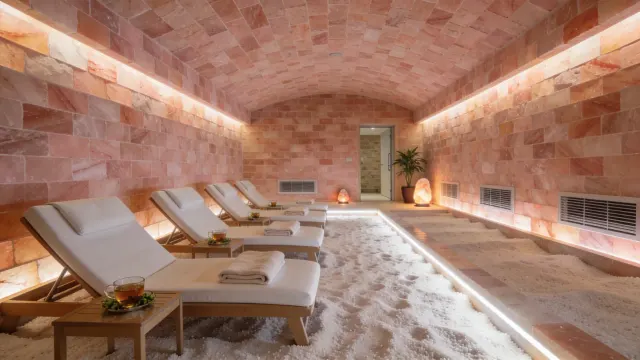
A salt room is an enclosed space set aside for dry salt therapy, also called halotherapy. Many are decorated with salt walls, salt bricks, or salt-covered floors, but the décor is not what makes it a salt room. What matters is the air: in an active salt room, a halogenerator fills the space with a fine, dry salt aerosol that you breathe during your session.
Salt rooms are found in day spas, wellness studios, and fitness and recovery centers, and more and more people now set one up at home. The idea is nearly two centuries old: it grew out of the salt mines of Eastern Europe, starting at Poland's Wieliczka Salt Mine in 1839. Read the full history of salt therapy.
How does salt room therapy work?
The halogenerator is the heart of the room. It grinds dry sodium chloride into particles of about 1 to 5 microns, small enough to stay suspended in the air, and a fan spreads them evenly through the space. Because the room is closed, the salt concentration builds and stays steady for the length of the session.
Salt is naturally hygroscopic, meaning it attracts moisture, which is one of the properties researchers look at when studying dry salt aerosol. For a closer look at the process, see how halotherapy works.
Active vs. passive salt rooms
| Active salt room | Passive salt room | |
|---|---|---|
| What's in the air | Dry salt aerosol from a halogenerator | Nothing added; salt stays on the walls |
| Salt | Pure pharmaceutical-grade sodium chloride | Himalayan, Dead Sea or rock salt décor |
| Counts as halotherapy | Yes | No |
| Best for | Dry salt therapy sessions | Ambiance, relaxation and meditation |
Not every room with salt on the walls offers halotherapy. The salt therapy industry draws a clear line between the two:
What do you do in a salt room?
Very little, and that is part of the appeal. Once the session starts, you sit or recline, breathe normally, and relax. Most people read, meditate, listen to music, or simply rest with their eyes closed. The only rule is to stay in the room for the whole session so you spend the full time in the salt-rich air.
How long is a salt room session?
Session length depends on the size of the room. Salt Therapy Association standards put sessions anywhere from about 10 to 45 minutes. In a large spa salt room shared by several guests, 30 to 45 minutes is common. In a small, sealed space like a home salt room or a pop-up tent, the salt concentration builds faster, so 10 to 15 minutes is often enough.
What to wear in a salt room
- Comfortable, everyday clothes. You stay dressed; there is no need to change.
- Socks. Many spa salt rooms have salt-covered floors and ask you to remove your shoes.
- Light colors if you can. Fine salt can leave a light dusting on dark fabric. It brushes off easily.
- Skip heavy creams. Leave thick lotions off before a session so the salt does not stick to your skin.
Salt room, salt cave, salt booth, or tent: what's the difference?
| Option | What it is | Where you find it |
|---|---|---|
| Salt room | An enclosed room with a halogenerator, often with salt décor | Spas, wellness studios, homes |
| Salt cave | A salt room designed to look like a natural cave, usually larger and shared | Spas and dedicated salt cave businesses |
| Salt booth | A small one- or two-person cabin with a halogenerator | Spas, gyms, recovery studios, homes |
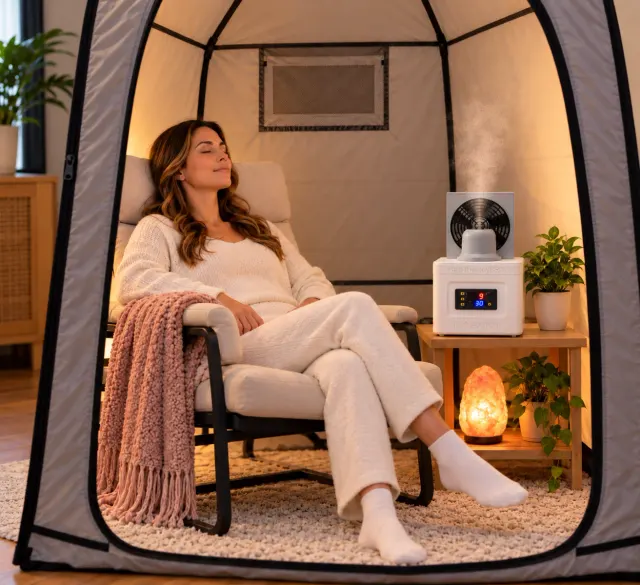
| Pop-up salt tent | A portable enclosure you set up at home and fold away after use | Homes and apartments |
| Sauna with halotherapy | A sauna fed by an exterior halogenerator, with or without heat | Homes, spas, wellness studios |
Who should check with a doctor first?
Salt room therapy is a gentle, drug-free wellness practice, and most people simply relax and enjoy it. It is a complement to medical care, not a replacement for it. Talk to your doctor before you start if you have a diagnosed respiratory condition, are pregnant, or are managing any ongoing medical condition, and keep following any treatment you have been prescribed.
How to create your own salt room at home
- Pick the space. A spare room, a salt booth, or a portable pop-up tent. Avoid bedrooms and living areas, because the fine salt settles on surfaces.
- Match the halogenerator to the size. The Lite Edition covers enclosed spaces up to 144 sq ft; the PRO, X and Pink Editions cover up to 225 sq ft. For a sauna, the Sauna PRO mounts outside the cabin.
- Keep it dry. Humidity should stay below 55%.
- Use pharmaceutical-grade salt. About a teaspoon per session; never Himalayan, sea or table salt.
- Plan the layout. See ideas in salt therapy room setup, or compare models in how to choose a halogenerator.
You do not need a spa to enjoy salt room therapy. All it takes is an enclosed space and a halogenerator:
Frequently asked questions
Are salt rooms good for you?
Many people use salt rooms to relax, unwind, and support their overall wellness routine, and researchers continue to study dry salt therapy. It is a complementary practice rather than a medical treatment, so check with your doctor first if you have a health condition. More in salt therapy benefits.
How often should you use a salt room?
Many home users enjoy two or three sessions a week, and some prefer a short session daily. In a spa, people often book a series of visits. Consistency matters more than session length.
Is a Himalayan salt room the same as halotherapy?
Only if it has a halogenerator. Salt walls and lamps create atmosphere but put no salt into the air. Halotherapy requires a halogenerator dispersing dry salt aerosol into the room.
Can I build a salt room at home?
Yes. A sealed spare room, salt booth, or pop-up tent plus a halogenerator sized for the space is all you need. No construction is required, and a tent can be folded away after each session.
What salt is used in a salt room?
Pure pharmaceutical-grade sodium chloride, with no iodine, anti-caking agents, or trace minerals. It is the salt the halogenerator turns into breathable particles. See our halotherapy salt.
Ready to create your own salt room at home?
Compare halogeneratorsHalotherapy is a complementary wellness practice and is not a substitute for medical treatment.