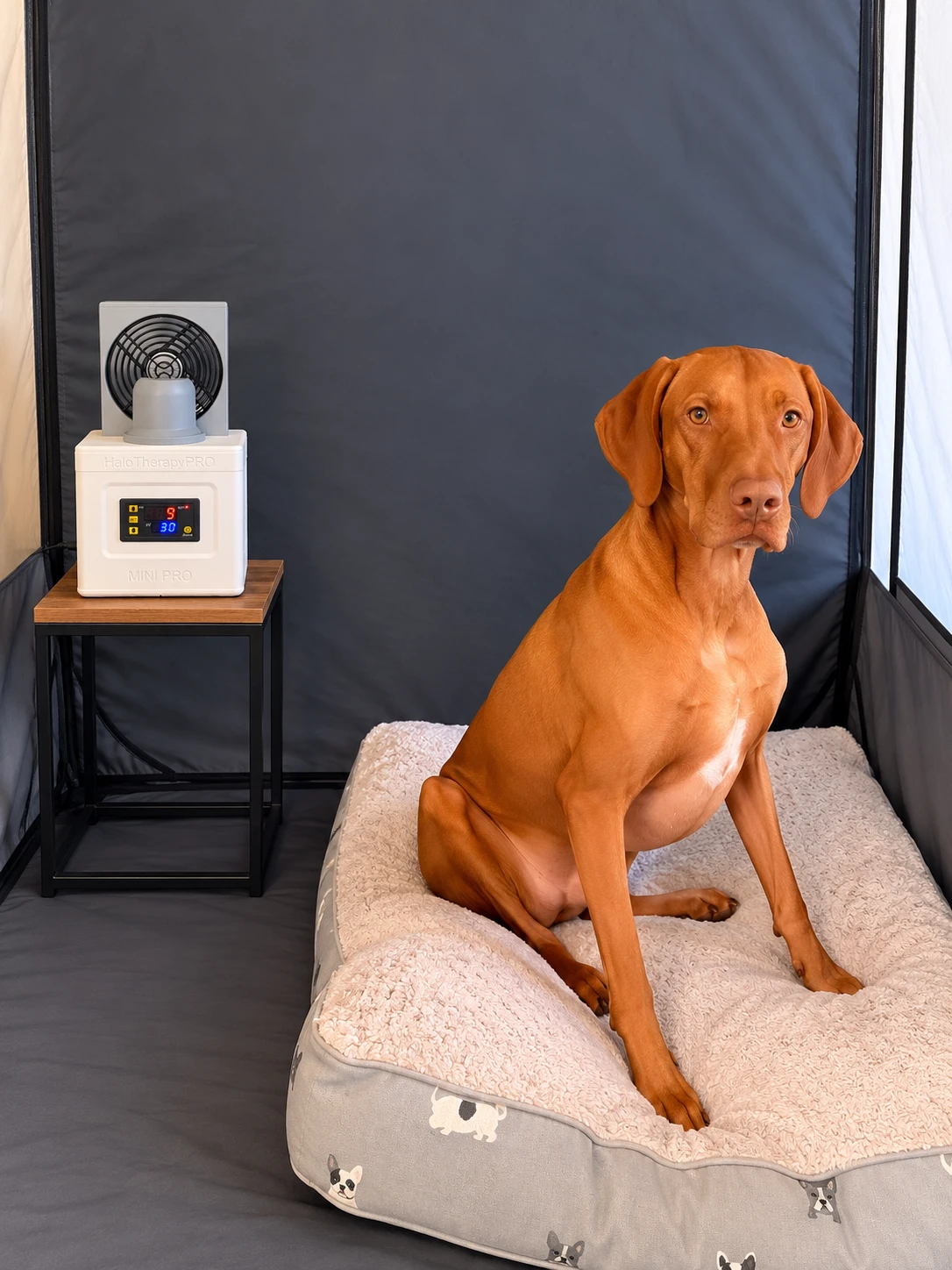
Animal Halotherapy
Exploring Dry Salt Therapy for Dogs
Active dry salt therapy, commonly known as halotherapy, is being explored beyond traditional human wellness environments. Some pet wellness businesses, integrative veterinary practices and other animal wellness providers list dry salt environments among their services.
Animal halotherapy uses the same basic principle as other active dry salt environments: a halogenerator mechanically grinds pure dry salt and disperses it into an enclosed space as an airborne dry salt aerosol.
For dogs, these environments may include dedicated pet wellness rooms, salt booths or appropriately sized popup tents. The suitability of the space and equipment depends on the animal, ventilation, installation requirements and veterinary guidance.
This page explores real-world canine halotherapy services, relevant scientific research and the considerations involved in creating a dry salt environment for dogs.
Animal halotherapy remains an emerging application with limited direct clinical evidence. Consult your veterinarian before considering it for your dog. It should not replace veterinary diagnosis or treatment.
Halotherapy for Dogs
Dry Salt Therapy for Canine Wellness
Halotherapy, commonly known as dry salt therapy, is not limited to human wellness settings. Some pet wellness centers, salt therapy facilities and integrative veterinary practices offer halotherapy sessions for dogs.
During a traditional canine dry salt-room session, a halogenerator grinds pure dry salt and disperses it into an enclosed space as a fine airborne aerosol.
A comfortable dog may rest and breathe normally while spending time in the environment. Traditional dry salt-room sessions do not require a mask, nebulizer or special breathing exercises.
Canine Wellness: Areas of Interest
Understanding the possibilities and the limits of current evidence
Interest in canine halotherapy often centers on breathing, skin comfort and a relaxed setting. These topics are worth discussing with a veterinarian, but they are not promises that a dry salt-room session will treat a condition or improve an individual dog's health.
Breathing and Airway Comfort.
Dry salt therapy is increasingly being explored as a complementary wellness experience for dogs. During a halotherapy session, finely ground dry salt is dispersed into the air, where dogs naturally breathe while relaxing in the space. Respiratory wellness is one of the primary areas of interest surrounding halotherapy for both people and animals. Pet wellness providers have explored its use as part of a broader wellness routine, particularly for dogs experiencing seasonal or environmental challenges. Halotherapy is complementary wellness and should not replace veterinary care for diagnosed respiratory conditions or breathing difficulties.
Skin and Coat Care.
During a halotherapy session, a dog’s skin and coat are naturally exposed to the dry salt environment as well. This has led to growing interest in halotherapy among pet wellness providers as a complementary approach to supporting skin and coat wellness, particularly for dogs experiencing seasonal or environmental skin sensitivities. Every dog is different, and persistent itching, irritation, sores, infections, or other skin concerns should be evaluated by a veterinarian.
Salt and Pet Wellness.
Dry salt has long been studied and used in a variety of wellness environments. In halotherapy, a halogenerator creates a controlled dry salt aerosol that is dispersed throughout the space. This provides a simple way for dogs to experience a dry salt environment without masks, nebulizers, injections, or invasive procedures. Halotherapy is intended to complement a dog’s overall wellness routine rather than replace veterinary diagnosis, medication, or treatment.
A Calm, Comfortable Environment.
Halotherapy sessions can also provide dogs with quiet time away from the normal activity of the day. A comfortable environment with gentle lighting, calming sounds, and familiar supervision can encourage dogs to settle naturally. Many dogs may choose to sit, lie down, or rest while spending time in the salt-air environment. Dogs should be allowed to become comfortable with the space at their own pace and should always be supervised.
A Simple, Non-Invasive Wellness Experience.
Room-style halotherapy is simple and non-invasive. Dogs simply spend time in a comfortable enclosed environment while the halogenerator disperses dry salt aerosol into the air. There are no masks, nebulizers, injections, or invasive procedures required. This simplicity can make halotherapy easy to incorporate into a broader pet wellness routine when appropriate for the individual dog. Dogs with existing health conditions should be evaluated by a veterinarian before beginning a new wellness routine.
Veterinary Perspectives and Growing Interest.
Interest in animal halotherapy continues to grow among pet wellness providers, salt therapy businesses, and some veterinary professionals. Respiratory wellness, skin and coat wellness, and the overall experience of spending time in a controlled dry salt environment are among the areas being explored. Research involving canine halotherapy remains limited compared with research involving people, so HaloTherapyPRO presents halotherapy as a complementary wellness experience rather than veterinary medical treatment.
Quiet Time Together
Halotherapy can also be an experience you share with your dog.
If the enclosure has enough space, you can sit inside with your dog during the session. For dogs that are more comfortable with their owner nearby, this can help make the environment feel familiar and reassuring.
You can also supervise from outside the enclosure if that is more comfortable for you and your pet.
Maintain a comfortable temperature, allow your dog to acclimate gradually, and never leave a dog unattended during a session.
Use only the salt specified for use with your HaloTherapyPRO halogenerator.
How Does Halotherapy for Dogs Work?
Canine halotherapy uses the same basic aerosol-generation principle as active dry salt therapy for people.
Pure dry salt is placed into a halogenerator, mechanically ground and dispersed into the air of an enclosed room, booth, popup tent or other appropriately designed space.
As a dog breathes, airborne salt particles can enter through the nose and mouth and come into contact with the respiratory tract. Particles may also settle on the coat and exposed skin.
Decorative salt walls and salt lamps do not produce this dry salt aerosol. Without a halogenerator, it is not active halotherapy.
Researchers have examined how sodium chloride aerosols interact with canine airway physiology, including mucociliary transport—the process by which mucus and inhaled material move through the respiratory tract. The study linked below investigated liquid saline aerosols in a laboratory setting, not traditional dry-room halotherapy.
Laboratory airway research — liquid saline aerosols, not a dry salt-room clinical trial.
A Simple, Passive Experience
One characteristic of a traditional dry salt-room session is that the participant does not need to perform a procedure. No mask, nebulizer or special breathing exercise is involved.
If the dog is comfortable in an appropriate environment, it may relax and breathe normally while its owner or handler supervises.
“Passive” describes the animal's participation, not the halogenerator. The equipment actively generates dry salt aerosol.
Flexible Session Options
Dog inside + owner supervising from outside.
In an appropriately sized enclosure, a dog may remain inside while its owner or handler maintains continuous supervision from outside.
The owner does not have to be inside the enclosure.
Dog and owner inside together.
An owner may remain inside with the dog when the enclosure provides enough usable space for both to sit or rest comfortably.
Shared use depends on the dog's size, the enclosure's dimensions and the installation requirements. It is not a universal fit guarantee.
Both options depend on the dog's comfort and an appropriate setup. The owner is not required to participate in the session. Neither option permits leaving the animal unattended.
How a Canine Halotherapy Session Works
This is an illustrative description, not a veterinary treatment protocol. Suitability should be reviewed with a veterinarian, and equipment and enclosure instructions must be followed.
The goal should always be a calm, comfortable experience. An animal should never be forced to remain in a halotherapy space. Do not publish a recommended session duration, frequency, salt output or exposure setting without appropriate supporting veterinary and equipment guidance.
- 1. Enter the Halotherapy Space: Allow the dog to enter an appropriately sized room, booth, popup tent or other suitable enclosure voluntarily. Do not force entry or confinement.
- 2. Get Comfortable: Give the dog time to settle. Depending on the usable space and the dog's comfort, the owner may supervise from outside or remain inside with the dog.
- 3. Create the Dry Salt Environment: The halogenerator grinds and disperses pure dry salt into the space. Keep the equipment protected from direct animal contact and follow its installation requirements.
- 4. Relax and Breathe Normally: No special breathing exercises are required. A comfortable dog may rest and breathe normally while being continuously observed.
- 5. Supervise Throughout: Maintain supervision and immediate access to the dog throughout the session, not only at the end. Stop the exposure and remove the dog if it appears uncomfortable or distressed.
Canine Halotherapy in the Real World
Animal halotherapy is an emerging wellness application. Some pet wellness businesses and integrative veterinary practices describe dry salt environments among their services.
The examples below illustrate services offered by independent organizations. They are not scientific proof of effectiveness and are not HaloTherapyPRO customers, partners or endorsements.
Natural Healing Pet Care.
Veterinary service example. Natural Healing Pet Care in Troy, Michigan lists a dedicated Salt Room (Halotherapy) among its integrative veterinary services. Its service information describes private sessions with salt dispersed into the room through a halogenerator.
New Moon Integrative Veterinary Care.
Veterinary service example. New Moon Integrative Veterinary Care in Hudson, Massachusetts describes pet halotherapy among its integrative veterinary services, using a specialized cabin where pets experience micronized salt during supervised sessions. Its page describes salt combined with infrared heat and optional red light.
Halo Pet Spa.
Commercial wellness provider. Halo Pet Spa in Carmel, Indiana describes halotherapy in a wellness environment for pets and their people. Its website lists several wellness modalities; this page only notes that halotherapy is among the services available.
Read About Halo Pet Spa: Independent news coverage — not scientific research.
Sedona Infinity Spa.
Commercial wellness provider. Sedona Infinity Spa describes pet halotherapy, providing another example of companion animals being included in salt-room wellness services.
A provider offering a service is not scientific proof of benefit. Treatment claims made by providers, news articles or equipment sellers are not adopted by HaloTherapyPRO.
What Does the Research Say?
Scientific research specifically examining traditional dry-room halotherapy in dogs remains limited.
Canine respiratory research has investigated how liquid sodium chloride aerosols interact with airway physiology and mucociliary transport. One study published in the Journal of Applied Physiology examined several aerosol exposures and reported different responses depending on the substance and concentration.
In the study, one sodium chloride exposure increased several measured transport functions, while another decreased bronchial mucociliary clearance. The findings should not be summarized as uniformly beneficial.
This laboratory research provides background on canine airway responses to saline aerosols. It was not a clinical trial of dry salt-room halotherapy, did not test HaloTherapyPRO equipment and does not establish that conventional halotherapy treats respiratory disease in dogs.
Laboratory / mechanistic animal research. Liquid saline aerosol — not a dry salt-room session.
This study is part of the HaloTherapyPRO research library, where it is filed under Animal & Veterinary Research.
Create a Halotherapy Space for Your Dog
A canine halotherapy environment does not need to resemble a decorative salt cave or permanent salt room. The essential component of active halotherapy is a halogenerator that creates and disperses dry salt aerosol.
Subject to veterinary guidance, equipment requirements and the suitability of the enclosure, potential settings include:
The space should be dry, clean, well maintained and large enough for the dog to remain comfortable. Ventilation and temperature must be considered during use as well as between sessions; an enclosed space must not be interpreted as airtight confinement.
Protect cables and the halogenerator from chewing, entanglement and direct animal contact. Maintain immediate access to remove the dog, and follow the equipment and enclosure instructions.
An owner may supervise from outside or remain inside if there is sufficient usable space. Continuous supervision is required in either case.
Human room-size recommendations alone do not establish animal suitability. No setup on this page is described as animal-tested, veterinary-approved or proven safe for animals.
- Home wellness spaces
- Popup halotherapy tents
- Salt booths
- Pet wellness facilities
- Integrative veterinary practices
- Canine rehabilitation facilities
- Grooming and pet spa businesses
- Dedicated pet salt rooms
- Other appropriately sized enclosed spaces
An Easy Way to Create a Halotherapy Space at Home
A permanent salt room is not required to create an active dry salt environment. A HaloTherapyPRO popup tent and halogenerator provide a compact enclosure option without permanently converting a room.
Where veterinary guidance and the equipment's requirements support the intended use, an appropriately sized dog may rest inside while its owner supervises from outside.
If there is enough usable space for both, an owner may choose to sit inside with the dog. Suitability depends on the dog's size, comfort, enclosure dimensions, ventilation and installation requirements.
The owner does not have to remain inside the tent. Continuous supervision is always required.
Active Dry Salt Therapy for Animal Wellness Spaces
HaloTherapyPRO halogenerators grind pure dry salt and disperse it into an enclosed environment. Different equipment configurations support different enclosure sizes, from compact spaces to larger dedicated rooms.
Potential professional settings include:
Equipment selection depends on the enclosure's dimensions, configuration, ventilation and installation requirements. Veterinary guidance is needed to assess the intended animal use; equipment sizing is not a substitute for that assessment.
- Pet wellness businesses
- Pet spas
- Integrative veterinary practices
- Canine rehabilitation facilities
- Grooming facilities
- Dedicated pet salt rooms
- Other appropriately designed animal wellness spaces
Interested in Adding Halotherapy to Your Pet Wellness Business?
Whether you are considering a dedicated pet salt room or an existing animal wellness space, HaloTherapyPRO offers halogenerators for a variety of enclosed environments.
Tell us about the type and dimensions of your space, and we can discuss equipment sizing and installation considerations. Your veterinarian should advise on suitability for the animals and the intended use.
Important Information for Animal Owners
Animal halotherapy is an emerging wellness application, and scientific research specifically examining traditional dry-room halotherapy in dogs remains limited.
Consult your veterinarian before considering halotherapy for your dog. It should not replace veterinary diagnosis, medication or treatment.
Dogs with respiratory disease, cardiovascular conditions, serious medical conditions, unexplained coughing, breathing difficulties or other health concerns should be evaluated by a veterinarian before beginning a new wellness practice.
Animals must remain continuously supervised. Stop the exposure and remove the dog from the environment if it shows distress or discomfort. Never force an animal to enter or remain in an enclosure.
The enclosure must provide sufficient space, appropriate ventilation and temperature management, protected equipment and immediate access to the animal. Follow equipment and enclosure instructions; do not treat an enclosed space as airtight confinement.
Research using liquid saline aerosols or other equipment should not be assumed to establish the safety or effectiveness of HaloTherapyPRO equipment or a dry salt-room session.
HaloTherapyPRO products are wellness products and are not intended to diagnose, treat, cure, mitigate or prevent disease in humans or animals.
Source references
Contact HaloTherapyPRO Explore HaloTherapyPRO Halogenerators